

 DE · German
 ES · Spanish
 FR · French
 NL · Dutch

Home » Health Hub for Dogs » Revitalise Your Dog’s Mind: Key Tips to Slow Brain Ageing
Revitalise Your Dog’s Mind: Key Tips to Slow Brain Ageing
By Glendon Lloyd, Dip. Dog Nutrigenomics (Distinction), Dip. Canine Nutrition (Distinction) · Founder, Bonza
Reviewed by Veterinary Advisory Board
Last reviewed November 2023
Reading time ~4 min

Good News: Slowing Brain Ageing and Cognitive Decline In Dogs Is Possible
As devoted pet parents, we revel in the joy and companionship our furry friends bring into our lives. But with ageing comes the inevitable challenge of cognitive decline. Just as humans face this reality, our canine counterparts are not exempt. Cognitive decline, or brain ageing, is increasingly common in dogs as they reach their golden years. Recent studies have revealed that 28% of dogs between the ages of 11 and 12 suffer from brain ageing, which escalates to 68% in those aged 15 to 16. With over 15 million dogs in Europe alone grappling with this condition, it’s clear that brain ageing in dogs is not an obscure ailment. (1)
Yet, not all news is bleak. Contrary to prevailing misconceptions, cognitive impairment isn’t a mandatory part of ageing, brain ageing is not rare, and, most importantly, there are preventive measures and treatments available.
Early Detection: The First Step Towards Intervention
Recognising the early signs of brain ageing, or canine cognitive dysfunction (CCD), is crucial. Symptoms such as disorientation, anxiety, irritability, changes in sleep patterns, and house-training lapses can be red flags. If you notice any of these signs, it’s time to consult with a vet. Bonza subscribers benefit from our VidiVet partnership, offering round-the-clock access to professional veterinary advice. If you suspect your dog may be showing signs of decline, consult your vet.
Understanding Risk Factors
Age, epilepsy, and a sedentary lifestyle stand out as significant risk factors for CCD. Knowledge of these can guide you in mitigating potential risks early on.
Empowering Your Ageing Dog: Therapies and Lifestyle Changes
Exercise
The adage “use it or lose it” applies as much to dogs as it does to humans. Regular physical activity, ranging from 30 to 60 minutes daily, is essential for maintaining both physical and mental health.
Mental Engagement
Mental stimulation is a potent deterrent against brain ageing. This can be as simple as changing walking routes or introducing new games. Consistency in routines also provides stability and comfort, particularly for ageing pets.
Nutritional Support
Perhaps one of the most ground-breaking areas in combating brain ageing is dietary intervention. The key to brain health in dogs lies in their nutrition. The inclusion of antioxidants and nutrients like Omega-3 and L-carnitine has been shown to combat oxidative stress—one of the culprits in brain ageing. (2)
Studies have demonstrated remarkable improvements in dogs over 7 years old fed antioxidant-rich diets, showing better performance in cognitive tasks and behaviour than dogs not fed antioxidant enriched food. (3, 4)
Moreover, an MCT-enhanced diet—rich in elements found in substances like coconut oil—has yielded improvements in attention, memory, and learning. (5, 6) Interestingly, a diet inherently rich in antioxidants might trump supplements alone in efficacy. (7)
A study, ‘Cognitive enhancement in old dogs from dietary supplementation with a nutrient blend containing arginine, antioxidants, B vitamins and fish oil‘, published by Cambridge Press in 2018 found that oxidative stress and inflammation are among the important causes of brain ageing and dementia (8, 9) and that a Brain Protection Diet (BPD) supplemented with a nutrient blend consisting of antioxidants, B vitamins, fish oil and L-arginine didn’t just slow brain ageing in dogs but contributed to a significant improvement in cognitive ability.
Science is increasingly finding the powerful link between the gut microbiota and the brain – the so-called gut-brain axis – in both humans and dogs. (8, 9, 10).
The most impactful way of altering your dog’s microbiome is through the use of probiotics.
Bonza’s cutting-edge formula, inclusive of PhytoPlus®, a proprietary blend of powerful anti-inflammatory and antioxidative phytonutrients, embodies this research, providing a dietary foundation fortified with antioxidants, anti-inflammatories, and mitochondrial cofactors, all of which are proven warriors against inflammation and oxidative damage—the archenemies of canine brain ageing.
Bonza is the only plant-based dog food with probiotics and Omega 3 DHA, EPA and DPA.
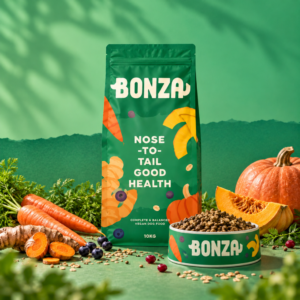
Bonza Superfoods and Ancient grains vegan dog food contains the following ingredients to support brain health:
- Probiotics – highly effective Calsporin
- MCT from virgin coconut oil
- Arginine
- Full spectrum of B vitamins
- Omega-3 DHA, EPA and DPA from algae
- L-carnitine
- Glucosamine and MSM
While brain ageing may be a daunting prospect, the power to change the narrative for your ageing dog lies in early detection, lifestyle adaptation, and nutritional improvement. With the right approach, you can open the door to a twilight period filled with vitality and mental sharpness, proving that indeed, you can teach an old dog new tricks—and perhaps more importantly, preserve the precious bond you share for as long as possible.
Related Resources
-

The HPA Axis in Dogs: How Chronic Stress Rewires Whole-Body Health
25/07/2026
The stress system behind your dog's itching, loose stools and restless nights is often the same one. Here is how the HPA axis works,…
read more The HPA Axis in Dogs: How Chronic Stress Rewires Whole-Body Health -
Vet Approved, Vet Formulated, Vet Founded: What These Dog Food Claims Tell You, and What They Don’t.
22/07/2026
"Vet approved" feels like a guarantee. The evidence on how little nutrition vets actually study, and who now owns the clinics, tells a more…
read more Vet Approved, Vet Formulated, Vet Founded: What These Dog Food Claims Tell You, and What They Don’t. -

Do Dogs Need Supplements, or Is a Functional Treat Enough?
15/06/2026
Not every dog needs a supplement, and a functional treat is not the same thing. Here is how to tell what your dog truly…
read more Do Dogs Need Supplements, or Is a Functional Treat Enough?