



 DE · German
 ES · Spanish
 FR · French
 NL · Dutch

The Environmental Impact of Animal-Based Diets: Make The Change
The Environmental Impact Of Producing Animals to Feed Dogs, Cats and Their Humans
It’s no secret that the livestock industry significantly affects our environment, and the environmental impact of dog food, cat food and human food is significant. Studies have consistently shown that this sector is responsible for a notable chunk – 20% – of all human-caused greenhouse gas emissions[3]. Moreover, recent findings by the Intergovernmental Panel on Climate Change in 2023 emphasized the urgent need for action by underscoring that climate change poses a substantial threat to our world[105]. The UN’s Secretary-General Antonio Guterres summed it up by saying that the need for climate action is urgent and comprehensive[106]. One common solution that has been frequently suggested is a shift towards plant-based diets[5, 6]. While most of these recommendations are aimed at humans, there’s a significant, often overlooked population that also consumes a lot of meat: our pets.
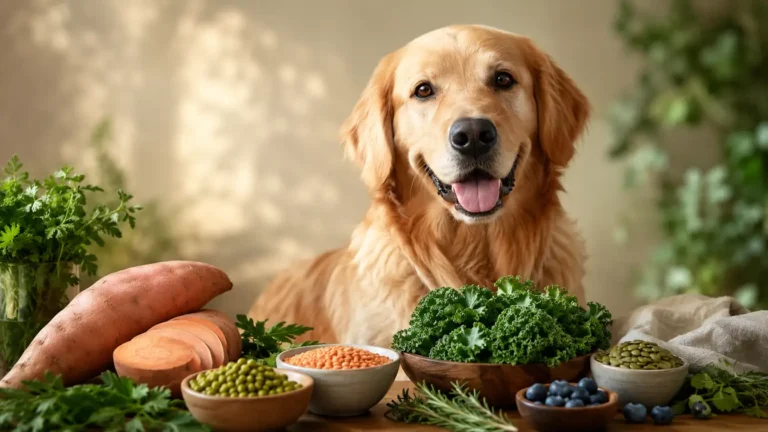
Dogs and cats, the beloved members of many households worldwide, are significant consumers of meat. Interestingly, the number of these domesticated animals globally is roughly 10% that of the human population, and this doesn’t even account for the strays or those living without owners. For a long time, many believed that these pets couldn’t survive, let alone thrive, on plant-based diets. This belief might have played a role in the absence of substantial dialogue regarding the dietary habits of these animals. However, recent research paints a different picture. Multiple studies have found that dogs[16–24] and cats[23, 25–27] can remain healthy on well-balanced vegan diets without any compromise to their behaviour or welfare[28].
Let’s look at some numbers for perspective:
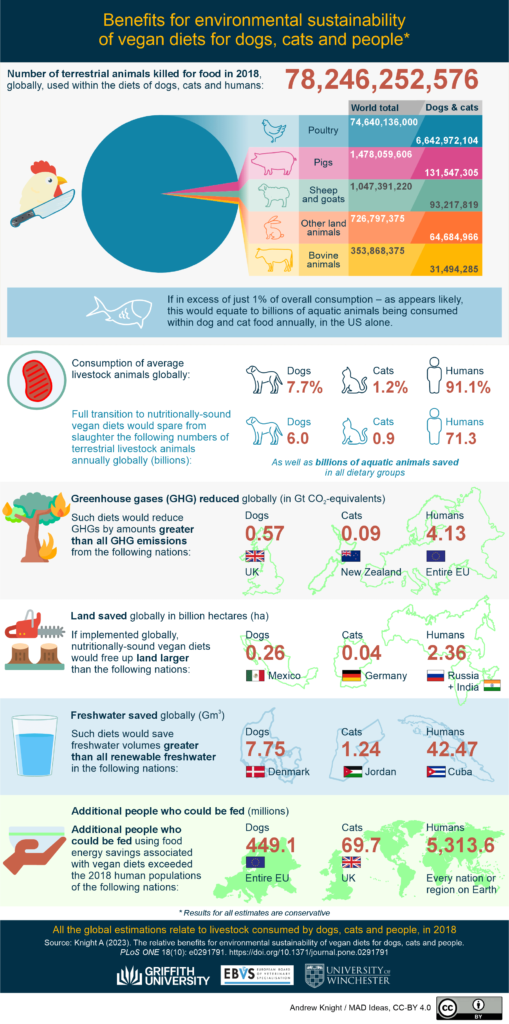
In 2020, the US had an estimated population of 86 million dogs, 61 million cats, and 329 million people. Globally, the 2018 estimates stood at 471 million dogs, 600 -1000 million cats (figures for cats provided by World Animal Foundation) , and a staggering 7.68 billion humans. Based on consumption patterns within the US, dogs consumed 17.7% of average livestock animals, cats 2.3%, and humans, unsurprisingly, took the lion’s share at 80.0%. The global numbers were slightly different, with dogs at 7.7%, cats at 1.2%, and humans at 91.1%. These differences, particularly the higher consumption by pets in the US, can be attributed to the nation’s affluence and the consequent higher levels of pet ownership.
By converting all these groups to balanced vegan diets, we could save billions of livestock animals annually, both terrestrial and aquatic. Here’s a snapshot:
- In the US: 1.7 billion saved by dogs, 0.2 billion by cats, and 7.8 billion by humans.
- Globally: 6.0 billion by dogs, 0.9 billion by cats, and a whopping 71.3 billion by humans.
This dietary shift’s environmental benefits are enormous. For instance, switching to plant-based diets would liberate land areas comparable to Saudi Arabia (for dogs) or Japan (for cats). Humans adopting vegan diets could free up a landmass equivalent to combining Russia, the world’s largest country, with India. The water savings would also be massive, exceeding the renewable freshwater resources of entire nations. Furthermore, the reduction in greenhouse gas emissions would be comparable to the total emissions of countries like South Africa (for dogs) or New Zealand (for cats), and even entire regions like the EU (for humans).
Additionally, the food energy savings from such a shift would be so vast that the amount saved from dogs, cats, and humans transitioning to vegan diets could respectively feed populations equivalent to the entire European Union, France or the UK, and every nation or region as defined by the World Bank[79].
While the potential benefits from humans going vegan are colossal, we shouldn’t underestimate the environmental impact of our pets’ diets. Especially in affluent regions like the US, the potential environmental savings from dogs transitioning to vegan diets can be up to a third of that of humans. As more nations develop economically and pet ownership becomes more widespread, these numbers are only expected to grow. Thus, rethinking our pets’ diets can be a crucial step towards a more sustainable future.
In conclusion, while the livestock sector’s environmental toll is significant, a shift to plant-based diets for both humans and pets offers a promising solution. As our understanding of nutrition evolves, it’s clear that vegan diets can be beneficial not just for us but also for our furry friends.
This is a precis of original research study conducted by Professor Dr Andrew Knight, ‘The relative benefits for environmental sustainability of vegan diets for dogs, cats and people‘ published in October 2023.
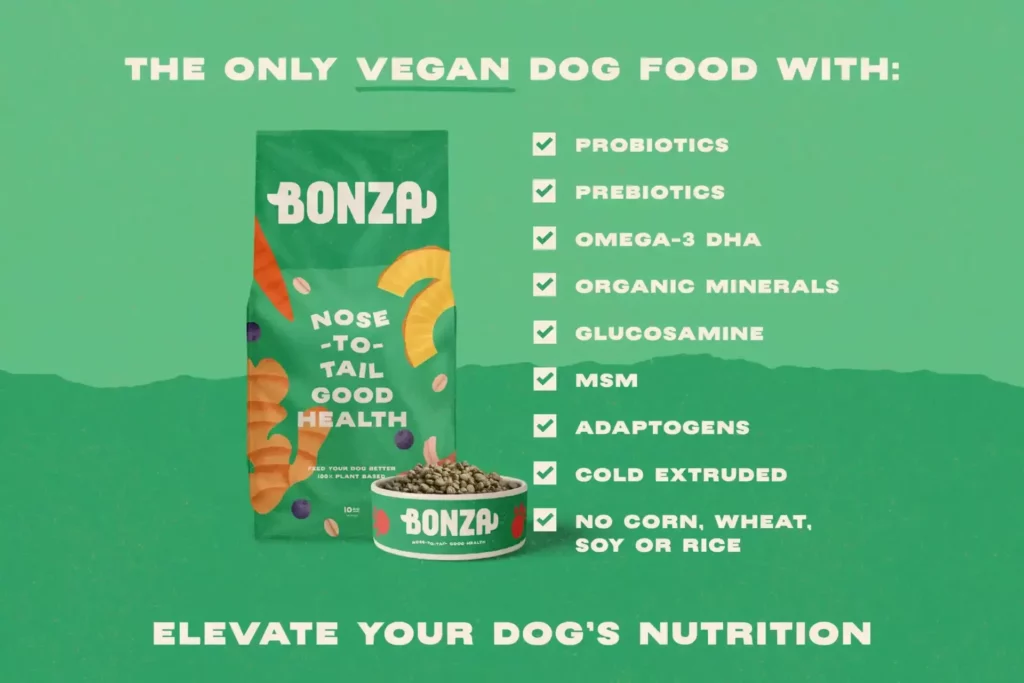
Bonza is a nutritionally complete vegan dog food with numerous unique health supporting inclusions – probiotics, Omega-3 with DHA, EPA and DPA, Glucosamine, MSM and adaptogens and botanicals.
Being plant-based, and sustainably sourced not only helps your dog’s health but also helps to reduce the environmental impact of dog food generally.
Healthier Dogs. Healthier Planet.